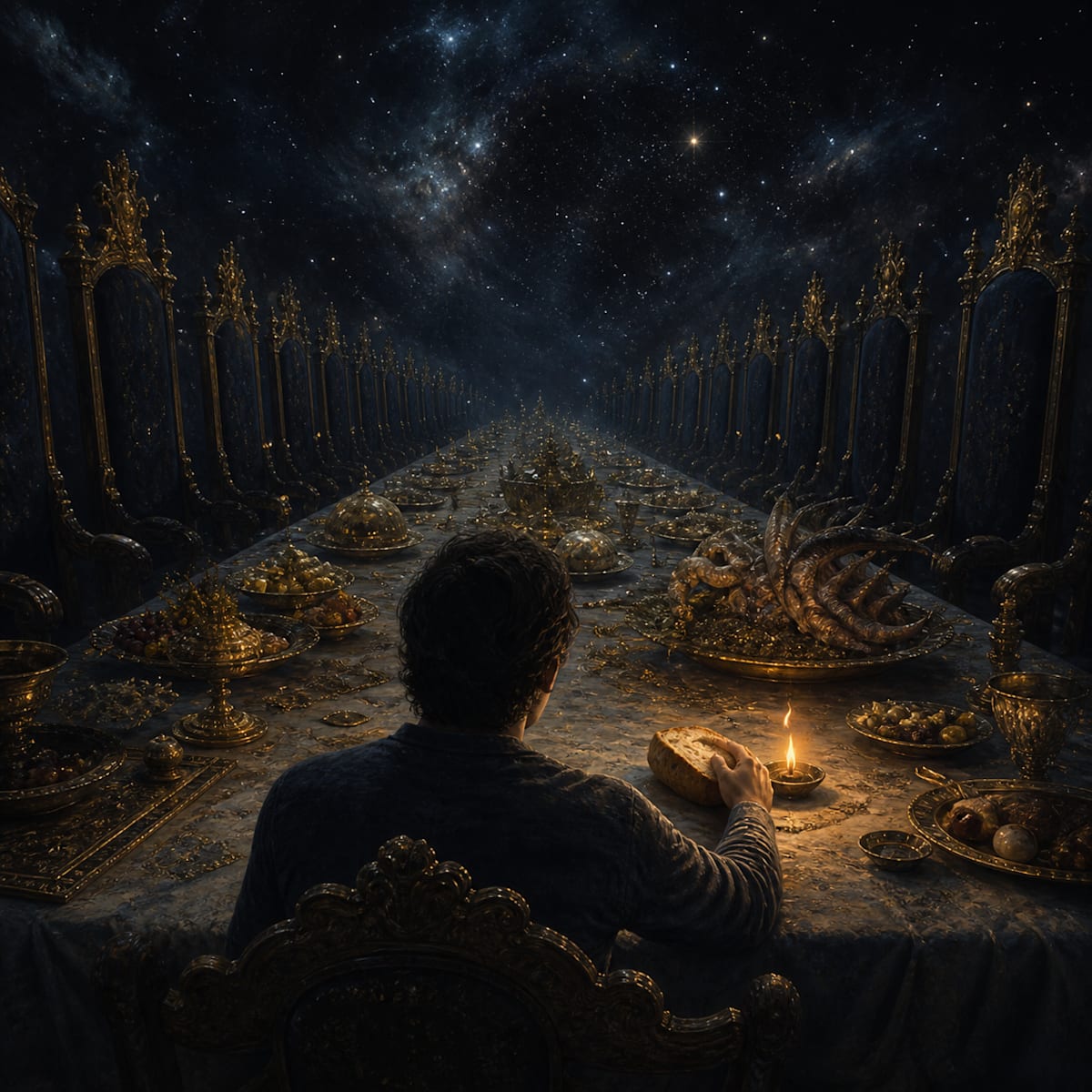
We hunger for meaning… but what is the question?
If life has no answers, why keep living?
Our god or gods remain silent.
Our inexpressible yearning for answers can only be described as deliberate torture imposed by an evil architect. For play… or for plan?
Does religion, philosophy, or science solve the mystery, or only give us a respite from the suffering?
Deluding yourself that they somehow do brings you to a paradox that repeats the question… with more questions.
So we look toward the exit sign in hope of some relief from the angst we all experience trapped in a quandary, wrapped in mystery, surrounded by a riddle.
So how do we, how can we… Live?
I would suggest to you and to remind myself… Surrender not your intelligence, but rather stand inside the riddle. Live only with satisfaction in the process.
Camus called this the absurd.
And refused to look away from it. And refused to die from it.
He said the only honest response was revolt — to keep living, with full awareness, in the face of a universe that owes nothing, nor will give you an answer.
Wax on.. Wax off. Perhaps meaningless motion is not so meaningless. But is it training?
For what?
The Next?
Therein lies yet another question. Another paradox. Is the apparent meaningless meaningful? For the play, the food of the gods… or for the plan?
Can we still live a full and fruitful life inside this forced doing? Can we trust the progression of the human species to do what we are doing, yet never grasp an answer we are capable of discerning…?
Can we be happy without escape? Defiant within the absurd. Joy and satisfaction as a prisoner with no final answer or charges explained.
Victor Frankl (Man’s Search for Meaning) showed us that even in the most extreme confinement, a human being may still possess an inner freedom. Not from pain. Not from horror. But freedom in how you bear witness. What you choose to serve. What you refuse to let be taken from you.
Kafka (The Trial) shows us a man arrested, but no one clearly tells him why. He is caught inside a vast, obscure, bureaucratic system that judges without revealing anything. He tries to reason with it. He tries to understand it. He tries to defend himself. The system is opaque. It is everywhere and nowhere. It has authority, but no clarity. A world where judgment exists without explanation. Guilt exists without an appointed crime. Procedure replaces disclosure. Yes, I used that word.
A human being is trapped inside a structure demanding obedience but refusing meaning.
Kafka was writing a novel. Jacques Vallée called it a control system and refused to say whose.
Philip K. Dick was writing both a novel and a confession, and at the end of his life, he could no longer tell you which. He called the thing that contacted him VALIS, Vast Active Living Intelligence System, and spent eight thousand pages of exegesis trying to file the paperwork.
Some of us have lived the procedure too. There are nights, and decades, when the system is not on the page but in the bedroom doorway. In the field behind the house. In the small voice of a being who knew your name before you did.
Different vocabularies. Same shape.
Kafka’s Josef K. would have understood all of them immediately.
Can you see the absurdity yet refuse to be conquered by it?
So what is the question? A hidden lesson, a discovered meaning, a conscious rebellion, or only a system feeding on your need for explanation?
Physics now asks you to accept that 95% of the universe is made of substances no one has seen, that the rate of cosmic expansion disagrees with itself depending on who measures it, and that string theory has resolved into a landscape of 10⁵⁰⁰ possible answers; the catechism does the same trick at lower resolution, every mystery referred to a higher office, the higher office referring it back.
Meaning, absurdity, discipline, suffering, the tease of physics or religion as a bureaucracy toward answers.
Or just a fragile, tiny ember at the end of the tunnel… of human freedom.
Maybe that is all we have.
Maybe that is enough.
Or maybe even that is only another question.